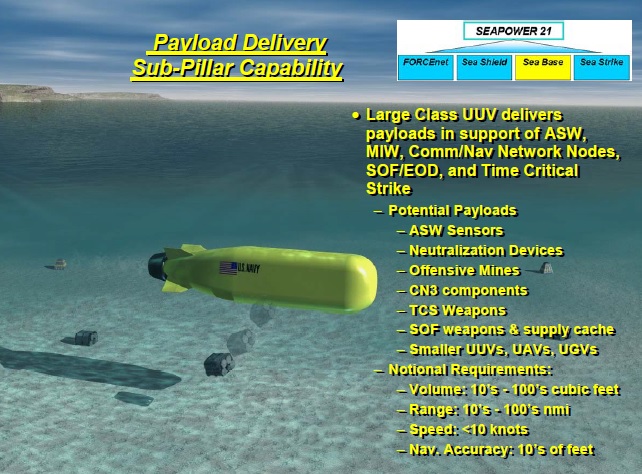
An Unmanned Underwater Vehicle. U.S. Navy photo.
A tense situation transpired 50 nautical miles northwest of Subic Bay in Zambales last Thursday when China seized the underwater drone installed by the United States Navy. Philippine top officials were unconcerned about it.
The Duterte government’s nonchalant attitude towards China’s seizure of the United States’ underwater drone in Philippine territory reflects its hazy understanding of sovereignty.
Sovereignty is the supreme right of the state to command obedience within its territory.
Defense Chief Delfin Lorenzana at Sulong Pilipinas conference. By CHARMAINE DEOGRACIAS, VERA Files
In a departure from the previous administration’s support of the United States freedom- of-navigation activities in the South China Sea, Defense Secretary Delfin Lorenzana said Thursday. the Philippines for will not allow the use of former American military bases – Clark and Subic -for FON patrols of the United States Armed Forces.
Lorenzana said President Duterte is not in favor of U.S. vessels venturing into disputed waters in the South China in the name of freedom of navigation.
“As he said we will avoid any provocative actions to de-escalate tension in the South China Sea. So I think it is unlikely (that Philippines will support US FON operations),” Lorenzana said in doorstop interview at the Pilipinas Conference held at the Peninsula Hotel.
Asked further to explain the Philippines’ turn-around, Lorenzana said, “We are just trying to avoid tensions because one of the things that we see there is, to the Chinese, we allow our land as base for the American’s incursion towards their area, so we will avoid that.”
By Charmaine Deogracias Vera Files Philippine President Rodrigo Duterte will visit Beijing on Oct. 20 and 21, in what reliable diplomatic sources say is a…
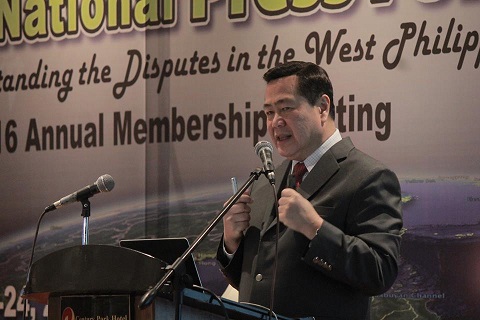
Senior Associate Justice Antonio T. Carpio at PPI June 23, 2016The Philippines is not exactly helpless if the United Nations Arbitral Court decides in our favor in the case we filed against China and China ignores it.
The Hague-based U.N. Artbitral Court is expected to decide on the case on July 7.
In Jan. 2013, the Philippine asked the U.N. court to
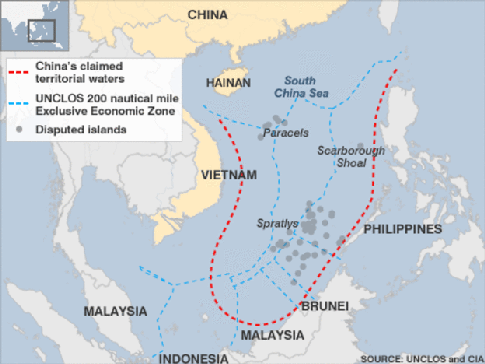
1. declare as illegal China’s all encompassing nine-dash line map;
2. declare as part of Philippine 350 nautical mile continental shelf low tide elevations (rocks or shoals that are seen only during low tide) where China has built permanent structures;
3. declare that the waters outside the 12 nautical miles surrounding the Panatag Island (Scarborough shoal) should be declared as part of the Philippines 200 natutical mile Exclusive Economic Zone.
CHINA is hopeful that relations with the Philippines will be better under the government of Rodrigo Duterte, who will succeed President Benigno Aquino III on July 1.
In a regular press conference in Beijing Wednesday, Foreign Ministry Spokesperson Lu Kang was asked about statements by Duterte that he is willing to talk with China and go into joint exploration in disputed areas in the South China Sea.
No amount of China’s protestation that the Oct 29 decision of the United Nations Arbitral Tribunal is “null and void” and it has “no binding effect” on them, cancels the fact that it’s a major blow to them.
Filipinos, on the other hand, should understand that the U.N. Arbitral Court’s decision, although a win for the country, does not award the disputed islands and waters of Spratlys to the Philippines.
That’s precisely because that is not what the Philippines asked from the U.N. Arbitral Tribunal when it filed the case against China on Jan. 22, 2013.
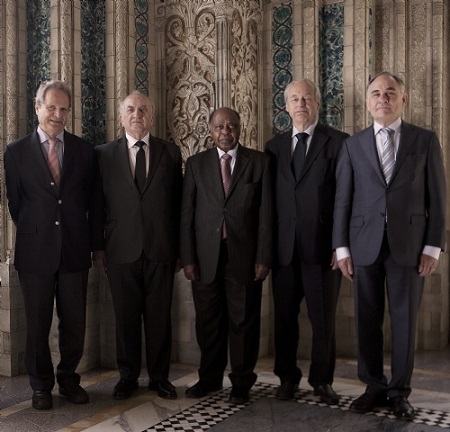
Members of the Tribunal: Judge Thomas A. Mensah of Ghana, president; Judge Jean-Pierre Cot of France; Judge Stanislaw Pawlak of Poland; Professor Alfred Soons of the Netherlands; and Judge Rüdiger Wolfrum of Germany.
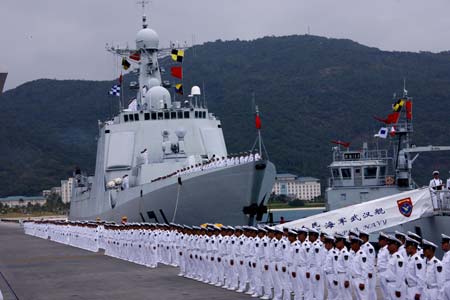
A ceremony is held before a Chinese naval fleet sets sail from a port in Sanya city of China’s southernmost island province of Hainan on Dec. 26, 2008.
Despite the fact that relations between China and the Philippines are bad, Chinese officials said “war is never an option” for China in resolving the territorial conflict in the South China Sea.
It is not in China’s interest to have an unstable South China Sea, said Tang Qi Fang of China Institute of International Studies based Beijing.
In a talk with members of Philippine media invited by China’s Foreign Ministry to mark the 40th year of diplomatic relations between the Philippines and China, Tang said if armed confrontation breaks out in the South China Sea, the loser will not be the Unites States. Not even the Philippines.
“It’s China,” Tang said adding that it’s because they have a lot of activities in the area.
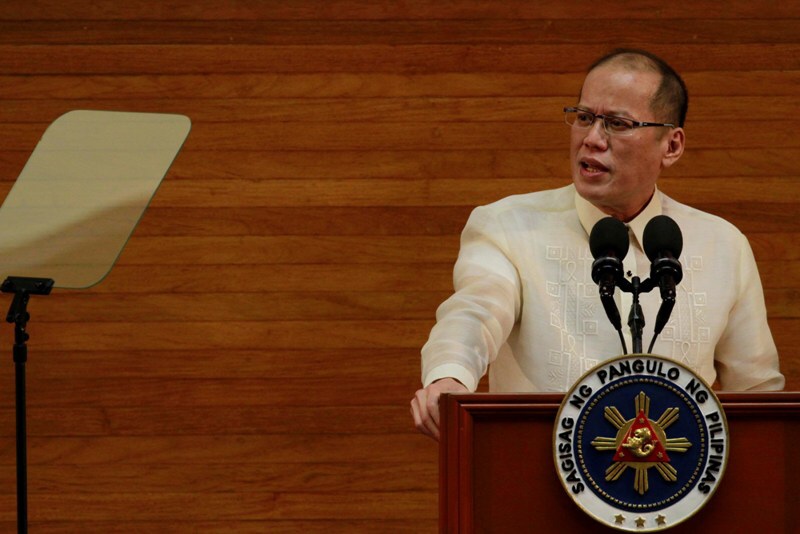
Pres.Aquino delivering his sixth and last State-of-the-Nation address.
It can’t be said that President Aquino has not learned anything in the last five years of his presidency.
We would like to think that his not mentioning the issue with China over territorial claims in South China Sea in his 6th and last State of the Nation address is an indication that he has learned from his mistakes of making unnecessary insulting comments that do not help at all advance national interest.
Maybe his not feeling well last Monday did not give him the opportunity to adlib. Or he would have repeated his favorite historical story of Sudetenland and once again compared China to Nazi Germany. Just what he did in his interview with New York Times before and early this year in his press conference in Japan.
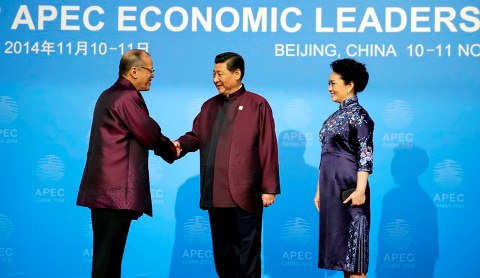
President Aquino is welcomed by China’s President, APEC 2014 in Beijing.
China’s President Xi Jinping may boycott the 2015 Leaders Meeting of the Asia Pacific Economic Cooperation (APEC) to be held in Manila on Nov. 18 and 19, a diplomatic source said.
The source said the reason for Xi’s change of mind about attending this year’s APEC summit was the remarks of President Aquino last month during his visit to Japan comparing China’s activities in South China Sea to Nazi Germany’s expansionism which led to World War II.
“That remark really got the ire of Xi Jinping. Didn’t Aquino think that by comparing Nazi Germany to China today, he was in effect saying Xi is like Hitler? “ the source said.